






 Trap
 Normal
Time Machine
View:
3848
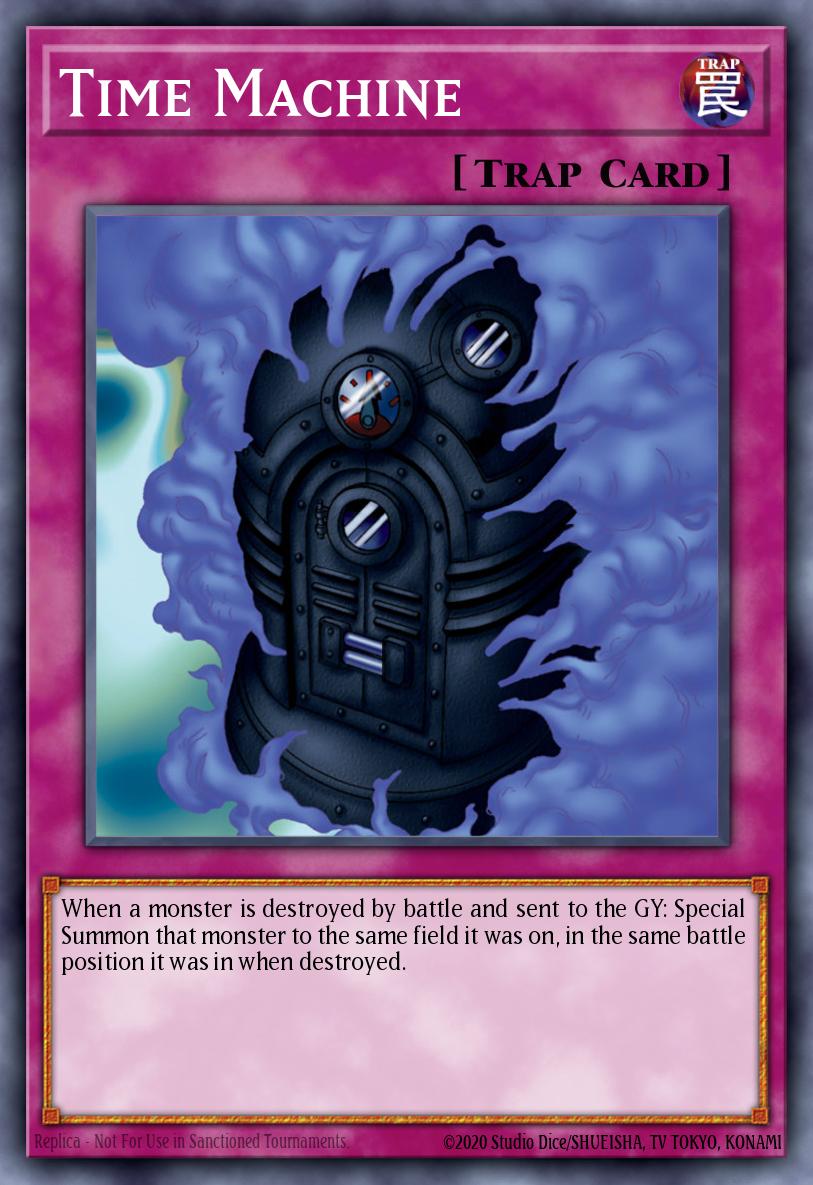
When a monster is destroyed by battle and sent to the GY: Special Summon that monster to the same field it was on, in the same battle position it was in when destroyed.
Time Machine — Power Evaluation
Final Score: 49 ± 8 · Confidence: Medium
- Intrinsic: 48 · Deck: 49 · Meta: provisional
- Primary role: Recovery/Recursion
Why it scores here
Time Machine is a reactive recursion trap: it only fires after one of your monsters is destroyed by battle, and then it returns that monster to the field in the same position. Its value is recovering a lost body for free, not building a board or interacting with the opponent's cards. It is a generic, low-cost card that 28 recent decks run across 15 archetypes, which confirms it is practical and accessible, but the sample gives no combo evidence that it converts into a winning line. High card popularity did not earn points on its own; the score rests on the text-defined recovery effect and the cheap deckbuilding cost.
Axis scores
| Axis | Score | Evidence |
|---|---|---|
| Accessibility | 40 | Trap card that must be drawn and set; no searchers or combo routes are recorded, though 28 decks run it (observed deck count, inference on access). |
| Combo & Conversion | 35 | Text-only: it converts a battle loss into a same-position revive, but no combo boards are recorded (inferred from text). |
| Resource Economy | 55 | Returns a monster from the GY at no card cost, a one-for-zero recovery when a battle trade happens (verified from text). |
| Effect & Interaction | 15 | No negation, removal, or disruption on the opponent's cards; it only acts on your own battle-destroyed monster (verified from text). |
| Material Utility | 10 | Trap card, not a monster, so it provides no material body (verified from text). |
| Resilience & Flexibility | 35 | A face-down trap that dies to any negate or backrow removal and only triggers in one situation (inferred from text). |
| Deck-Building Efficiency | 70 | Usually 1 copy per deck (avg 1.25, max 3), no garnet or lock restriction, and it fits many archetypes (observed from decks). |
Calculation
Weight profile: Primary role Recovery/Recursion, no secondary roles. Intrinsic ≈ 48, Deck ≈ 49, Meta = provisional. Modifiers: none. Final formula: 0.40*Intrinsic + 0.60*Deck
Strengths
- Reliable one-for-zero recovery of a monster lost in battle, returned to the same field and position
- Generic: appears across 15 archetypes, with partners like Harpie's Feather Duster, Monster Reborn, and Polymerization
- Cheap to run: about 1 copy per deck with no garnet restriction
Weaknesses
- Only triggers after a battle destruction, so it is dead in many hands and situations
- Set trap that is vulnerable to negation and backrow removal
- No opponent interaction and no board or card-advantage engine
Counters / choke points
- Negation of the set trap
- Backrow removal or trap destruction
Best use
Recovery of a battle-destroyed monster in a deck that already runs battle-based attackers. Decks: Red-Eyes, Heroic, Fur Hire. Suggested copies: 1.
Evidence & gaps
- Verified: Effect text: when a monster is destroyed by battle and sent to the GY, Special Summon it to the same field and position; Runs in 28 of the sampled decks, 1.25 copies on average (max 3)
- Observed: Appears in 15 distinct archetypes, most often Red-Eyes (7) and Heroic (5); Top co-occurring cards include Harpie's Feather Duster, Monster Reborn, and Polymerization
- Inferred: Recovery is conditional on a battle destruction, which limits reliability; Dies to negation and backrow removal as a set trap
- Data gaps: no combos supplied — combo conversion is text-only inference no guides supplied no banlist token — assumed 3 copies (unlimited) no usage statistics (StatisticsCard) — archetype inclusion % inferred from deck sample only